
USDH, Polymarket's US Return & Fireblocks Stablecoin Payment Network
Interesting crypto news from the week of September 8th.

Hyperliquid’s USDH Stablecoin Showdown
Hyperliquid, the fast-growing perp DEX with billions in USDC deposits, is trying to capture the revenue Circle currently earns on those reserves by launching a native stablecoin: USDH. Instead of minting it themselves, they opened a bidding war among issuers: Paxos, Frax, Sky, Agora, Native Markets, and others to see who would get the right to issue and manage reserves. The prize? An estimated $150–220M/year in yield that would otherwise flow to Circle.
Issuers are tripping over themselves to win. Paxos revised its pitch to pledge 95%+ of reserve yield back to Hyperliquid’s ecosystem and even dangled integrations with PayPal/Venmo. Frax and Sky offered 100% yield sharing, while Agora promised full buybacks and assistance fund contributions. Ethena initially bid but later backed Native Markets, a Hyperliquid-aligned team. The common theme: everyone is groveling because losing USDH means missing a blueprint deal that could reshape how DeFi protocols handle stablecoin revenue.

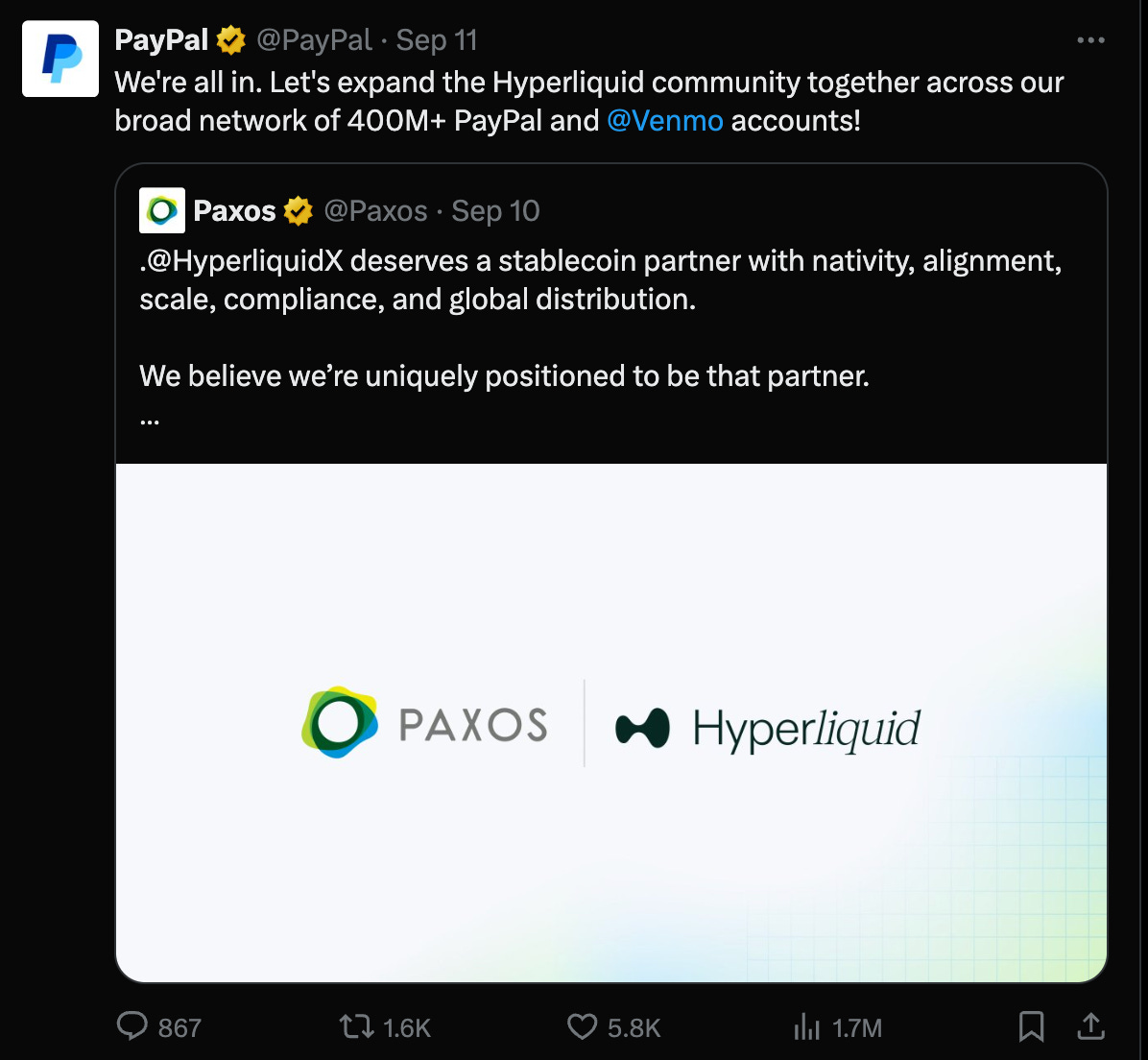
For Circle and Paxos, the stakes are existential. Circle in particular risks watching billions in USDC balances migrate to USDH, cutting off a fat interest stream. They’ve scrambled to announce native USDC on Hyperliquid to stay relevant, but the vibe is clear: Hyperliquid wants less dependence on external issuers and more alignment with its community. As I write this, validator voting has ended, and Native markets has won.
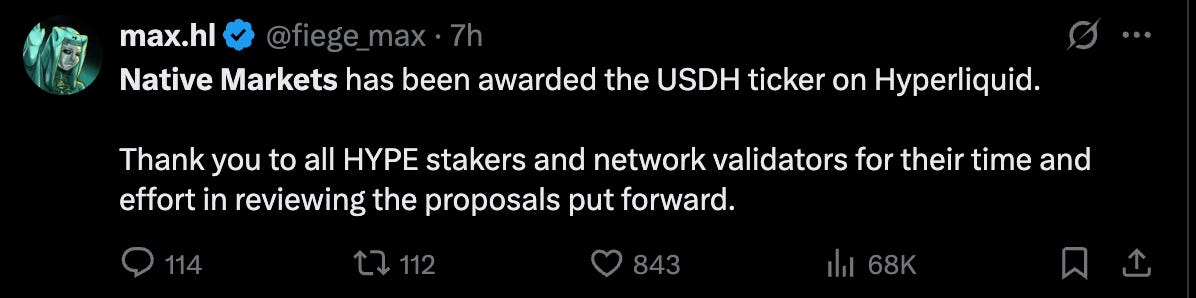
Native Markets’ victory over Circle, Paxos, Frax, and the rest is more than just a governance result. It is a reshaping of power dynamics in stablecoins. Hyperliquid is effectively saying it does not need to outsource one of the most profitable pieces of its business to legacy issuers. By choosing a Hyperliquid-aligned team, the community keeps the estimated $150–220M per year in stablecoin yield flowing back into HYPE buybacks, ecosystem funds, and protocol growth instead of to external shareholders.
STABLECOIN ISSUER SHOULD BE TERRIFIED!
If Hyperliquid can stand up a native stablecoin with community-aligned economics, why would other protocols from perp DEXs to lending markets to entire L2s not follow the same model? Stablecoin issuers used to dictate terms. Now they are at risk of being reduced to commodity service providers, fighting for protocol relationships rather than the other way around.
The optics are huge too. Circle and Paxos bent over backwards with promises of regulatory credibility, revenue sharing, and even PayPal and Venmo rails. Yet the community still chose a crypto-native upstart. That decision signals a cultural and financial preference: DeFi wants control, yield, and alignment to stay in the ecosystem. Native Markets’ win is the first real crack in the issuer moat, and Hyperliquid just proved protocols can make the big names grovel and still lose.
Polymarket gets the Greenlight in USA

If you don’t know what Polymarket is, its a crypto based prediction market that’s called elections and real world events remarkably faster than traditional media outlets.
In 2022, the CFTC charged Polymarket for offering off-exchange event based binary options contracts to US users without registering as a designated contract market or swap execution facity. In the settlement they were forced to block American users.
Earlier this year, Polymarket acquired QCX, a CFTC registered derivatives exchange. QCX’s licences acted as a legal wrapper and the CFTC issued a no action letter easing reporting and record keeping requirements. Effectively green-lighting Polymarket’s relaunch in the US.
Fireblocks launches a stablecoin payments network
Fireblocks just unveiled its Stablecoin Payments Network, branded as global infrastructure to power stablecoin payments across more than 100 countries. It connects local payment rails like ACH in the US and SEPA in Europe, fiat on and off ramps, blockchains, stablecoin issuers, and liquidity providers into a single streamlined system.
Think of it as SWIFT for stablecoins, but faster and simpler. SWIFT is the global messaging system banks use to tell each other to move money across borders. The problem is that it is slow, expensive, and clunky, often taking days and requiring multiple intermediaries. Fireblocks wants to replace that with near instant onchain value transfer that is fully compliant and always on.
The pitch is straightforward: one API integration gets you access to the entire network. Banks and fintechs no longer need to build bespoke pipes to Circle, Paxos, or each counterparty bank. Once connected, they can send or receive stablecoin payments anywhere else on the network. Settlement happens in minutes instead of days, without correspondent banks clipping fees, and with compliance controls and audit trails built in.
The target customers are anyone moving money at scale, from global banks to fintechs to corporate treasurers. Everyone is competing to own the global stablecoin payments stack right now, from Fireblocks to Tether to Circle to Stripe. Fireblocks is positioning itself as the backbone that makes stablecoin payments feel like sending an email.